Will it appear, or will it represent forever
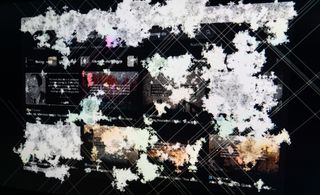
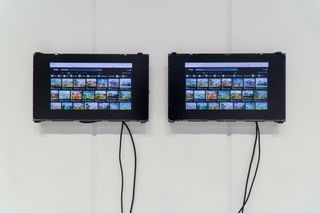
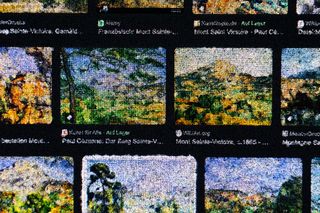
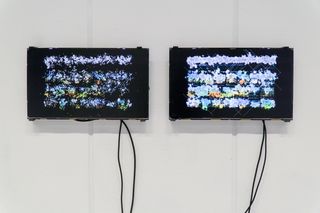
This series of works is grounded in the question if we can develop new sensibilities when understanding and engaging with computation as a formal-mathematical method rather than as a tool, platform, user interface, etc. The works incorporate this question within their setup and by highlighting an fundamental mathematical property of computation: incomputability. Each work consists of a computer, a running program, two screens, and an image that serves as the initial state for the program. The program slowly morphs the initial image and displays its current state on one screen and an accumulation of all states on the other.
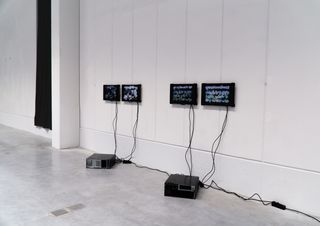
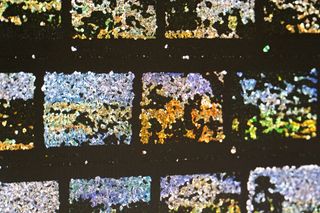
The core algorithm of Will it appear, or will it represent forever? is a cellular automaton – an algorithm that uses a two-dimensional grid of cells as data structure and processes the next state of each cell based on its neighbor cells. In the case of these works each pixel of the initial image is represented by one cell and the program then morphs the initial image further and further with its execution. The morphing process has an uncomputable behavior, meaning it is logically impossible to know how long the algorithm will need to run until it stops (for an arbitrary input). This includes also the possibility that the algorithm might not stop at all. On the two screens the recipients can follow this computational process. The right screens shows the current cells of the program. The left screen shows all states in transparent layers stacked on top of each other referencing the techniques of layering in painting.
Between the algorithm, the computational process, the initial images and the resulting images on the screens, the works constitute a constellation within which questions of sensibility and arts in relation to computation arise, but also question about our understanding of computational systems as rational tools.
In 1936, english mathematician Alan Turing proved the existence of incomputable mathematical questions and with it he made explicit that there are limits of what can be mechanically done or in todays terms: what can be automated. It is also possible to derive Turing's results a more graspable sentence: for a complex enough computational system there is no mechanical way to decide wether its output is correct or not. For example, the companies behind current large language models (LLMs) and the related chatbots (e.g. ChatGPT) will not be able to completely prevent unwanted behavior nor incorrect answers. The quite funny example of the seahorse emoji prompt shows this uncomputable behavior: until last year prompts like "does a seahorse emoji exist?" put ChatGPT into a sometimes endless loop of responding with different emojis, "pretending" they are the seahorse emoji, "realising" they are not a seahorse emoji, and responding with a different non-seahorse emoji … The companies might always be able to stop a specific case, like the seahorse emoji prompts, but there is logically no way of preventing all of them. From a more general perspective, the uncomputable formally puts into question the idea of artificial intelligence as one closed technological system that automatically (re-)produces knowledge (beside all the ontological problems of such a closed system). Anyhow it is in the context of the arts were it becomes apparent that automation qua (re-)production of closed answers is not desirable when it comes to a valuable encounter with somebody or something from which new meaning might arise. This does not mean that for example current chatbots completely prevent such an encounter. But the motivation and metaphysical understanding behind them is rooted in the anthropomorphisation of machines. It needs at least a re-interpretation of these machines and following from it, probably also a re-design of their architecture and of their so-called training methods: Strip chess of its goal to win, it might become a dance.
Thanks to Patrick Mölk for the brainstorming sessions on designing the algorithm.
Also thanks to Christian Putz for his mathematical advice.